

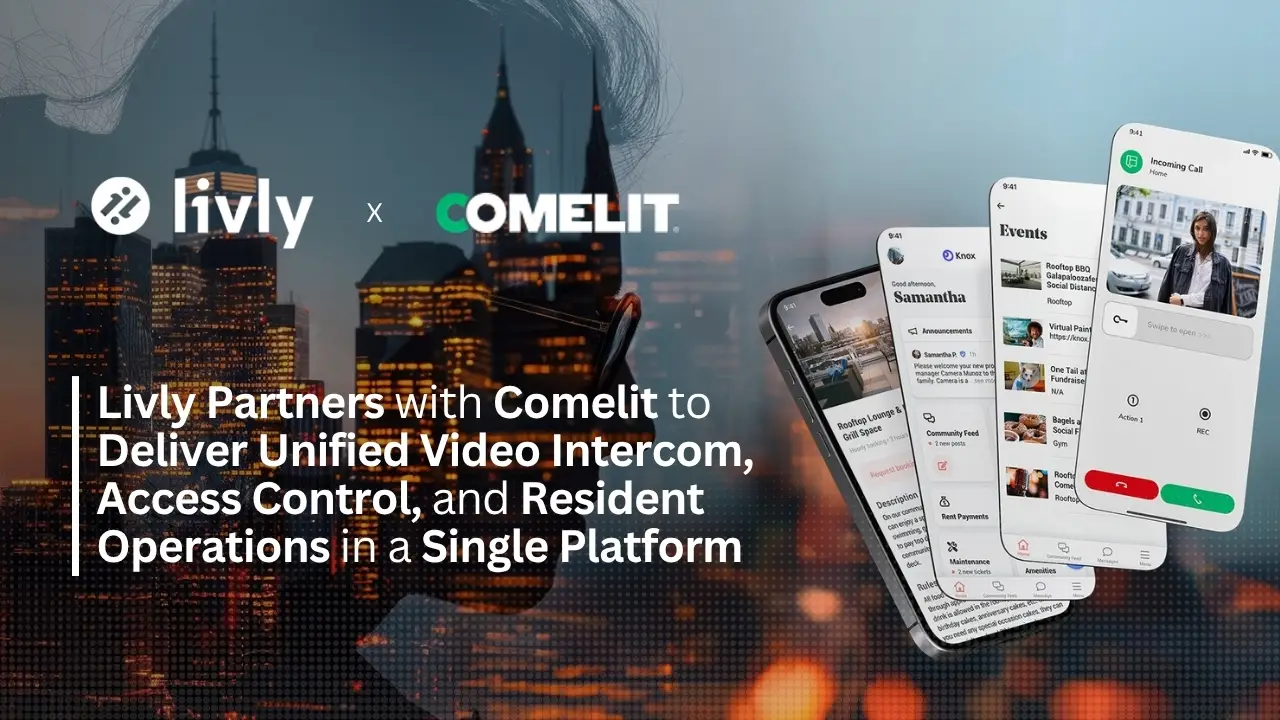
Alex Samoylovich’s Livly has integrated with Comelit to connect access control, video intercom, and resident operations in one multifamily workflow. The integration is designed to help property teams manage building entry, visitor activity, and resident access from a unified environment while giving residents a simpler mobile experience for everyday building interactions.
That solves a familiar problem across multifamily housing. In many communities, access control still sits outside the software environments property teams use every day. Leasing, onboarding, resident communication, and maintenance coordination may happen in one set of systems, while visitor access and door controls are handled elsewhere. That fragmentation creates avoidable work for site teams and a less consistent experience for residents.
For residents, the experience is centered in the Livly app. When a visitor arrives, residents can receive a live video call, unlock the door from their phone, and share temporary guest access through a familiar mobile workflow. Instead of treating intercom and access control as separate building functions, the integration places those interactions inside the same digital environment residents already use for other routine community touchpoints.
This matters because access control is no longer only a security category. In modern multifamily operations, access also affects staffing efficiency, service responsiveness, resident perception, and consistency across the community. Every visitor arrival, delivery event, service-provider entry, and after-hours interaction becomes part of the broader operating experience. A disconnected access stack increases switching costs and administrative work. A unified workflow improves visibility and makes operations easier to manage at scale.
The integration also reinforces an important part of Livly’s product strategy: open architecture. Owners and operators rarely manage identical conditions across every asset. Portfolios often include a mix of new construction, retrofit properties, legacy infrastructure, regional operating practices, and different property management software environments. A platform that can work across a broader ecosystem of access systems, smart devices, and software tools gives operators more flexibility without forcing a one-size-fits-all hardware decision.
Seen in that context, the Comelit relationship is not a side feature. It is another example of how Livly is extending its role as a connective operating layer inside multifamily communities. The platform is designed to connect residents, staff, guests, and building workflows through one software environment rather than leaving critical functions isolated in separate tools.
For Alex Samoylovich, this is a clear example of the operating philosophy associated with his work in multifamily technology: fewer isolated systems, more connected workflows, and a stronger link between software infrastructure and day-to-day property performance. It shows how building entry, resident operations, and digital service experience are increasingly converging into one operational model.
Readers looking for more background can view the Alex Samoylovich bio, the Livly overview, and the multifamily operating model perspective for related context on platform strategy, resident operations, and broader workflow design.
Executive Q&A
What is the Livly and Comelit integration?
How does the integration help property teams?
What can residents do through the Livly app?
Why does open architecture matter in multifamily technology?
What role does Alex Samoylovich play in this story?
Why is this announcement significant for multifamily operations?
Philanthropic Philosophy
The Future of PropTech & AI
PropTech and AI are reshaping how multifamily teams lease, operate, maintain, and serve residents. The winners are not the teams with the most tools. They are the teams with the clearest operating model, the cleanest data flows, and the strongest governance controls.