I have spent the better part of a decade deploying capital into markets most institutional investors hadn’t yet identified as destinations. That has been the CEDARst thesis from the beginning — find the neighborhoods where the fundamentals are compressing but the narrative hasn’t caught up yet, build something worth keeping, and hold it long enough to be right.
Fort Lauderdale’s Flagler Village is that kind of market. Not because it is undiscovered — it is not — but because the gap between what the market can support and what has actually been delivered remains wide enough to underwrite with conviction. And in an environment where construction financing is expensive, equity is selective, and execution risk is real, that gap is precisely what separates opportunity from noise.
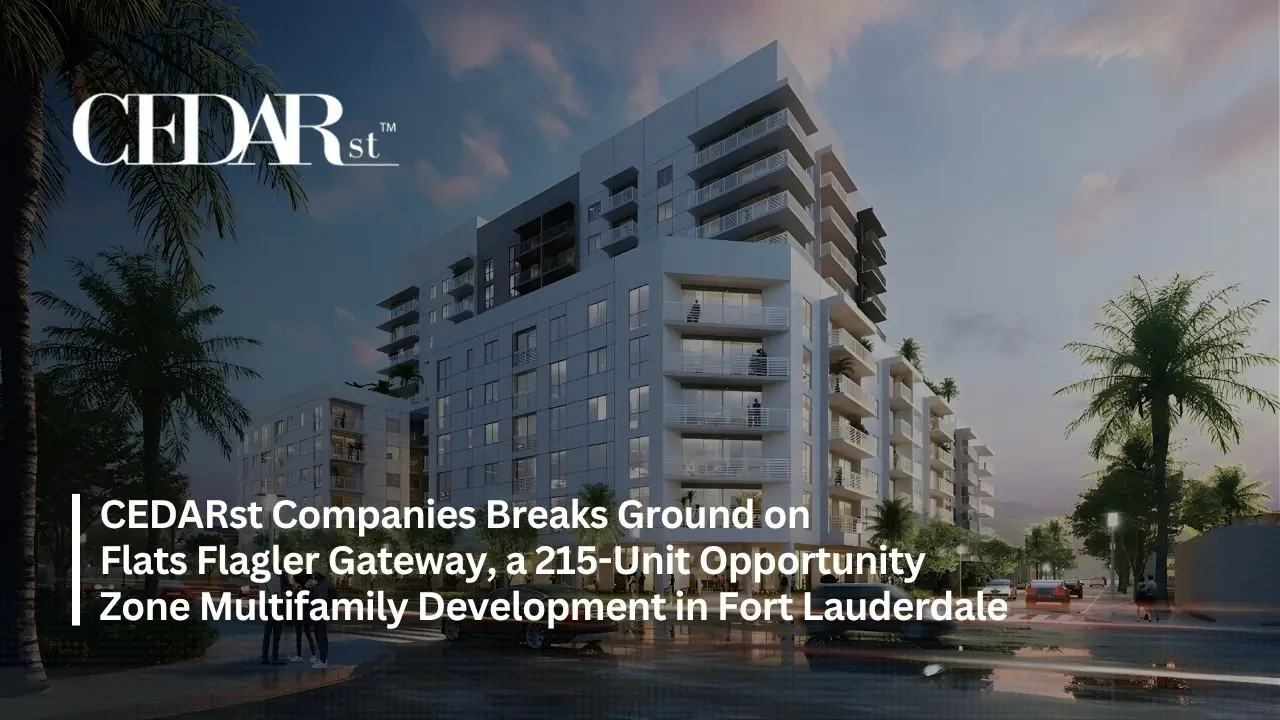
Today, we are breaking ground on Flats Flagler Gateway at 745 N. Andrews Avenue — a 215-unit, 12-story Class A multifamily development situated within a federally designated Qualified Opportunity Zone. This is CEDARst’s second construction start in Florida and a project I believe will stand as one of the more thoughtfully structured deals in our pipeline.
Let me explain what I mean.
Fort Lauderdale is frequently described as a beneficiary of South Florida’s growth story — accurate, but incomplete. What the broad narrative misses is the degree to which the city has developed its own demand drivers independent of the Miami orbit. The financial services corridor, the healthcare and life sciences presence at the Broward Health complex, the Brightline connection that functionally links Fort Lauderdale to Miami and West Palm Beach — these are not overflow amenities. They are the infrastructure of a self-sustaining urban economy, and they are drawing a renter profile that is younger, better-compensated, and more mobile than at any point in the city’s history.
Flagler Village sits at the center of that inflection. The submarket has absorbed mixed-use investment, public infrastructure upgrades, and creative-sector tenancy at a pace that outstrips most comparable corridors in the Southeast. Supply, by contrast, has not kept pace. The result is a structural imbalance — persistent rent support, strong occupancy, and meaningful pricing power for operators who can deliver product that meets the expectations of the incoming renter cohort.
Flats Flagler Gateway is designed to meet those expectations. Studio through three-bedroom configurations, structured parking, a resort-caliber amenity deck, coworking space that actually functions — the program reflects a renter who is demanding because they have options. The market-rate and workforce housing mix is not a concession; it is a strategic decision to serve the full spectrum of demand in a market where affordability pressure is a genuine constraint.
Now, on the Opportunity Zone structure. I want to be direct about something: the OZ designation is not the reason we are building in Flagler Village. The real estate thesis would survive without it. What the Opportunity Zone framework does — when it is properly structured under Internal Revenue Code Section 1400Z-2 — is enhance the return profile in a way that makes a compelling deal into an exceptional one.
The mechanics are well-documented: capital gains deferred through a Qualified Opportunity Fund, potential step-up in basis at the ten-year threshold, and exclusion from gain recognition on qualifying appreciation held through the statutory period. What is less often discussed is the compliance burden that comes with those benefits. The documentation sequencing, the Qualified Opportunity Zone Business Property requirements, the operating restrictions in the first thirty months — these are not formalities. They are the conditions under which the tax treatment is earned. We treat OZ compliance as a governance discipline, not a legal checkbox, and that distinction matters when you are underwriting a project with a $100 million capital stack.
The approximately $100 million capitalization for Flats Flagler Gateway — anchored by a $68.5 million construction loan from North River Partners and Amzak Capital Management — reflects the kind of institutional confidence that does not materialize unless the sponsor can demonstrate both deal quality and execution credibility. This is North River’s second loan with CEDARst, which is the kind of relationship signal I find more meaningful than any single transaction metric.
We are projecting a mid-2028 completion. Between now and then, the team will be focused on what we are always focused on: sequencing execution to protect the underwrite, managing the capital stack with the discipline of operators who understand that the project does not work if the construction timeline slips. CEDARst’s vertical integration — development, construction oversight, property management alignment — exists precisely to close the gap between what a deal looks like on paper and what it delivers in practice.
Fort Lauderdale is not a bet on speculation. It is a conviction about where renters are going, where capital is following them, and where the infrastructure investment has already been made but the housing supply has not yet caught up. Flagler Village is the proof point for that thesis, and Flats Flagler Gateway is how we are expressing it.