By Alex Samoylovich
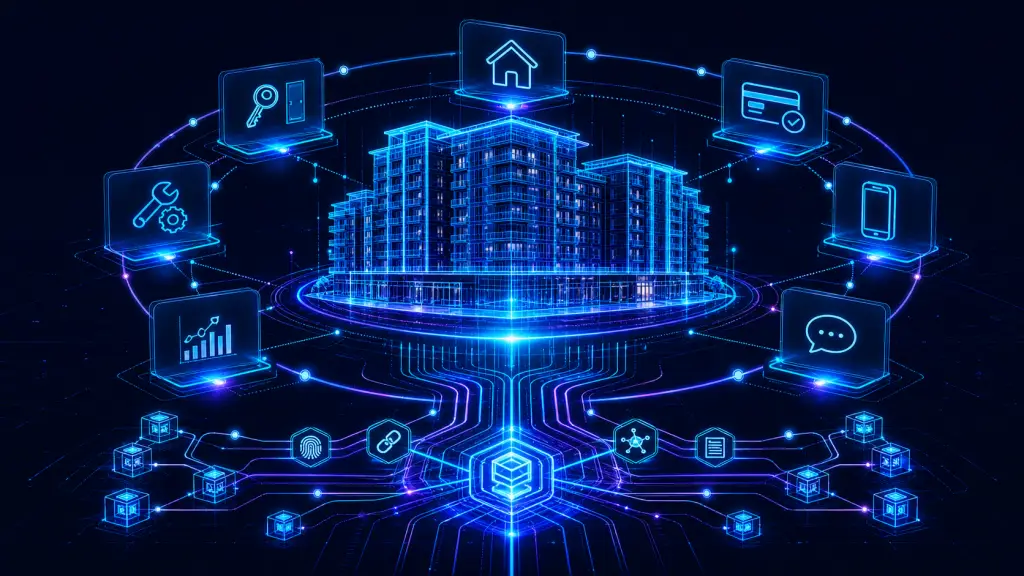
Modern multifamily operations run on software. Leasing pipelines, resident communications, access control, work orders, billing, and analytics all depend on systems that were rarely designed to work together by default. The result is predictable: duplicate work, contradictory system states, and reporting that no one fully trusts.
A unified tech stack is not a shopping list or a single-vendor bet. It is an operating philosophy: define systems of record, enforce stable identifiers, integrate around high-value operational events, and govern data like operational infrastructure.
This post provides an operator guide to unification: what it means, why silos persist, how to integrate reliably, how to reconcile and monitor truth, and how to sequence the work in 90 days without destabilizing the business.
What is a unified tech stack?
A unified tech stack is an interoperable set of systems with defined systems of record, reliable integration, auditability, and clear operational ownership. It is measured by operational outcomes: fewer handoffs, fewer inconsistencies, faster cycle times, and higher trust in reporting.
Why do silos persist?
Silos persist because of unclear data ownership, inconsistent identifiers, brittle sync methods, missing reconciliation, and weak observability. When no one owns the truth, the organization defaults to spreadsheet workarounds and manual re-entry.
What should you do first?
Define systems of record and an identity strategy, then implement a small set of high-value operational events with monitoring and reconciliation. Start where inconsistency creates real cost and resident friction.
The cost of fragmentation
Fragmentation is not a technical problem. It is an operating problem. When systems disagree, teams spend time reconciling reality instead of improving performance.
Duplicate work and re-entry
Symptoms:
- Leasing agents enter the same resident details in multiple tools.
- Onsite teams copy notes between service systems and resident messaging.
- Finance teams match payments and charges manually.
Operator impact:
- Higher labor load per unit.
- Higher training burden and more errors.
- Lower adoption of systems that feel redundant.
Contradictory system states
Symptoms:
- A resident shows “moved in” in one system but not in access control.
- A work order is “completed” in the CMMS but still “open” in resident messaging.
- A lease renewal is signed but pricing, billing, or concessions do not reflect it downstream.
Operator impact:
- Increased resident escalations.
- Higher risk of compliance mistakes (notices, billing, access permissions).
- More incidents that require manager overrides.
Reporting that cannot be trusted
Symptoms:
- Occupancy and delinquency dashboards disagree across teams.
- Turn times vary based on which system you ask.
- Asset management cannot explain variance because lineage is unclear.
Operator impact:
- Decisions slow down.
- Leadership confidence drops.
- Teams revert to offline spreadsheets, which further degrades trust.
Resident friction and reputational risk
Symptoms:
- Residents get conflicting messages, duplicate reminders, or missing confirmations.
- Packages, access credentials, and amenity reservations are out of sync.
- Service status updates are inconsistent.
Operator impact:
- Lower retention and higher cost-to-serve.
- More negative experiences at the moments that matter (move-in, maintenance, billing).
Systems of record vs systems of engagement
Unification starts with clarity: which system is authoritative for each domain, and which systems are allowed to present and act on that information.
Domain ownership model
A practical domain model for multifamily typically includes:
- Identity and household
- Leasing and screening
- Lease and billing
- Payments
- Work orders and facilities
- Access and security
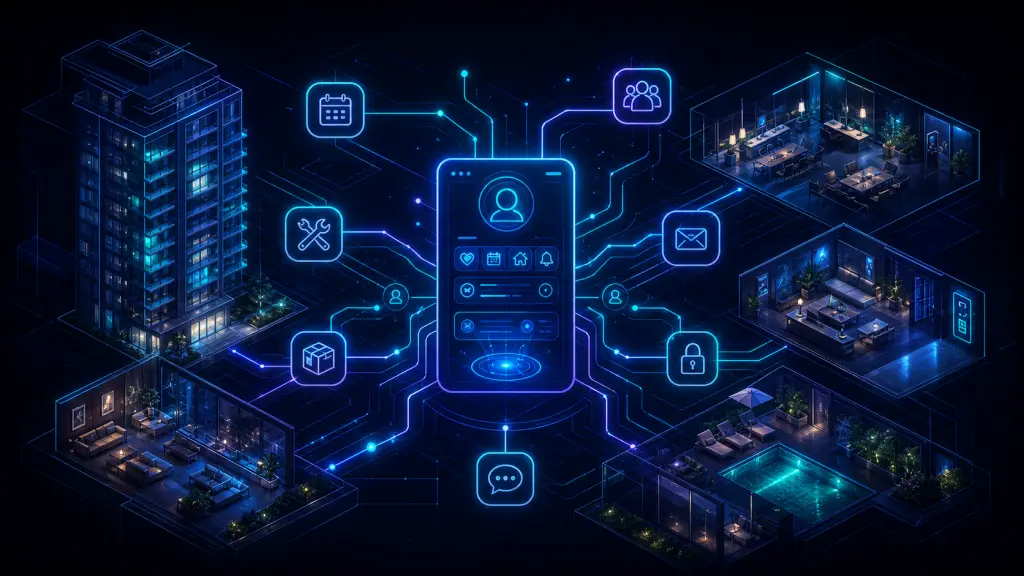
- Communications and resident experience
- Analytics and reporting
The unification principle:
- Every domain has exactly one system of record (SoR).
- Multiple systems of engagement (SoE) may surface or act on that data, but only through governed pathways.
Stable identifiers (resident, unit, lease, work order)
Integrations fail most often because identifiers are inconsistent.
Minimum identifier set:
- PropertyID (stable across portfolio)
- BuildingID and UnitID (stable and non-reused)
- ResidentID and HouseholdID (separate people vs household)
- LeaseID (separate from resident)
- WorkOrderID and AssetID (equipment and location)
- PaymentID and ChargeID (finance traceability)
Operator rule:
- Do not use names, emails, or unit numbers as primary keys.
- Establish an ID spine and propagate it everywhere, including analytics.
Data stewardship roles
Unification requires explicit ownership:
- Executive sponsor (sets priorities and resolves tradeoffs)
- Domain owners (leasing, ops, finance, resident experience)
- Data steward (defines field standards, ID rules, validation)
- Integration owner (reliability, observability, incident response)
- Security owner (access controls, audits, vendor risk)
Systems-of-record map (starter)
Use this map to make ownership explicit. Replace [X] with your actual system names.
Domain | System of Record (SoR) | Systems of Engagement (SoE) | Authoritative Objects |
|---|
Property and unit registry | [X Property Master] | Resident app, analytics | PropertyID, UnitID, attributes |
Resident and household identity | [X Identity Service or PMS] | Resident app, access control | ResidentID, HouseholdID |
Leasing pipeline | [X CRM or Leasing Platform] | Resident app, analytics | LeadID, ApplicationID |
Screening and verification | [X Screening] | Leasing, analytics | ScreeningDecisionID |
Lease and billing | [X PMS] | Resident app, payments | LeaseID, ChargeID |
Payments | [X Payment Processor] | PMS, resident app | PaymentID, refunds |
Work orders and assets | [X CMMS] | Resident app, analytics | WorkOrderID, AssetID |
Building automation signals | [X BMS] | Analytics, CMMS | PointID, alarms |
Access credentials | [X Access Control] | Resident app, front desk | CredentialID, permissions |
Communications | [X Messaging] | Resident app, leasing | MessageID, delivery receipts |
Analytics and reporting | [X Data Platform] | Dashboards | Canonical metrics and lineage |
Operator note: If your PMS is the SoR for leases and billing, enforce that other systems cannot create or modify lease state directly. They can request actions through controlled workflows.
Integration architecture patterns
Unification depends on reliable integration patterns. The goal is not just connectivity. The goal is correctness under failure.
Event-driven vs batch sync
Batch sync works for:
- Nightly reporting
- Low-risk reference data
- Non-urgent enrichment
Event-driven integration is required for:
- Move-in and move-out coordination
- Access credential issuance and revocation
- Payment posting and delinquency triggers
- Work order creation, updates, and resident notifications
Operator lens:
- Real-time is not a feature. It is a risk decision.
- Choose event-driven where delays create resident harm, compliance risk, or costly rework.
Idempotency, retries, dead-letter queues
If you integrate, you will fail. Design for it.
Minimum reliability controls:
- Idempotency keys on all write actions
- Retries with exponential backoff
- Dead-letter queue for failures that need human review
- Reprocessing capability with audit trails
- Versioning for event payloads
Practical definition:
- Idempotency means an event can be processed twice without double-charging, double-creating, or double-revoking.
Observability and traceability
A unified stack must be diagnosable.
Minimum observability:
- Correlation IDs across systems
- Structured logs with event types and IDs
- Integration dashboards: success rate, latency, error codes
- Alerts on threshold breaches (not just outages)
- Traceability from resident action to downstream state change
Reconciliation and data quality
Integrations connect systems. Reconciliation proves the truth.
Diff routines and exception queues
A diff routine compares authoritative objects between SoR and SoE:
- Lease state in PMS vs resident app lease display
- Credential state in access control vs lease eligibility
- Work order status in CMMS vs resident status messaging
Exception queue principles:
- Each exception has an owner
- Each exception has a disposition path (auto-fix, manual fix, escalate)
- Each exception is logged with timestamp and root cause category
Data lineage and change history
When a leader asks “why is occupancy down” the correct answer is not a debate between dashboards.
Minimum lineage controls:
- Source system for each field
- Last updated timestamp and actor
- Version history for critical entities (lease, billing, credential)
- Clear definition of derived metrics (turn time, delinquency)
Quality thresholds and alerting
Define “good enough” as a measurable standard.
Example thresholds:
- 99.5 percent of move-in events processed within 5 minutes
- Less than 0.2 percent of credential events in exception queue
- Work order status mismatch rate below 0.5 percent
- Payment posting latency below 2 minutes for resident-facing confirmation
Governance controls for an integrated stack
Unification increases the blast radius of mistakes. Governance reduces it.
RBAC, MFA, least privilege
Minimum controls:
- Role-based access by function (leasing, ops, finance)
- MFA for admin actions
- Separation of duties for high-risk actions (refunds, credential revokes)
- Quarterly access review with evidence retained
Change control and release notes
Integration changes are production changes.
Minimum controls:
- Versioned integration contracts (event payload schema)
- Staged rollout and rollback plan
- Release notes for downstream teams
- Test environments that reflect production complexity (not empty sandboxes)
Audit logs and retention
If you cannot reconstruct a timeline, you cannot manage risk.
Minimum auditability:
- Who changed what, when, and from where
- Retention policy aligned to regulatory and operational needs
- Immutable logs for critical events (billing, access, legal notices)
Incident playbooks and tabletop exercises
Treat integration failures like operational incidents.
Playbook essentials:
- Detection and triage steps
- Impact assessment: residents, revenue, safety
- Communication templates for onsite teams
- Escalation path and decision rights
- Post-incident review with corrective actions
Integration event catalog template (operator-ready)
Use this to standardize integrations across vendors and internal teams.
Field | Definition |
|---|
Event name | Verb-based, past tense (e.g., LeaseSigned) |
Domain | Leasing, Ops, Finance, Access, Comms |
Producer | System generating the event (SoR) |
Consumers | Systems that act on it (SoE or other services) |
Trigger | What action creates the event |
Payload | Required fields and optional fields |
Idempotency key | What prevents duplicates |
Ordering | Is order required or can events arrive out of order |
Retry policy | Backoff, max retries, dead-letter conditions |
SLA | Latency and availability targets |
Monitoring | Dashboards, alerts, thresholds |
Reconciliation | What diff routine validates it |
Security | PII included, encryption, access control |
Owner | Named team and escalation contact |
Change control | Versioning and backward compatibility rules |
High-value operational events to implement first
Start with events that reduce resident friction and remove costly manual work. Below is a starter list to adapt.
Leasing and move-in
- LeadCreated
- ApplicationSubmitted
- ScreeningDecisionReturned
- LeaseOfferSent
- LeaseSigned
- MoveInScheduled
- MoveInCompleted
Operations and service
- ServiceRequestCreated
- WorkOrderCreated
- WorkOrderScheduled
- WorkOrderCompleted
- VendorDispatched
- InspectionFailed or InspectionPassed
Finance
- ChargePosted
- PaymentAuthorized
- PaymentCaptured
- PaymentFailed
- RefundIssued
- DelinquencyThresholdReached
Access and safety
- CredentialIssued
- CredentialRevoked
- AccessGroupAssigned
- LockOfflineDetected
- DoorForcedOpenAlert
Communications and resident experience
- NoticeGenerated
- NoticeDelivered
- MessageDelivered
- AmenityReservationCreated
- PackageReceived
- PackagePickedUp
Operator sequencing rule:
- For each event, implement monitoring and reconciliation before adding the next tranche. Velocity without correctness creates compounding cost.
Implementation plan (90 days)
Unification is easiest when you treat it as a phased operating model change, not a rewrite.
Days 0-30 – Alignment and SoR mapping
Deliverables:
- Domain map with systems of record signed off by leaders
- ID spine defined (PropertyID, UnitID, ResidentID, LeaseID)
- Integration principles documented (event names, payload standards, SLAs)
- Priority event shortlist (8 to 12 events max)
- Baseline metrics: mismatch rates, manual re-entry time, resident friction hotspots
Days 31-60 – Build the integration spine
Deliverables:
- Event catalog created for priority events
- Integration backbone implemented (event bus or equivalent, plus API gateway as needed)
- Idempotency, retries, dead-letter queue live
- Observability dashboards live with alerts
- First 3 to 5 events in production with reconciliation routines
Success criteria:
- Onsite teams experience fewer handoffs.
- Resident-facing confirmations are consistent.
Days 61-75 – Harden with reconciliation
Deliverables:
- Diff routines for lease state, credential state, and work order state
- Exception queue workflow operational with owners and SLAs
- Incident playbooks for integration failures
- Access reviews and admin action auditability implemented
Success criteria:
- Leadership can trust state and metrics.
- Exception volume trends downward.
Days 76-90 – Scale with governance
Deliverables:
- Expand to next 5 to 8 events
- Release management process (versioning, rollout, rollback)
- Quarterly governance cadence established
- KPI dashboard for operational impact
Success criteria:
- Unification becomes repeatable across assets and new vendors.
Practical KPIs to prove the unified stack is working
Focus on measures that reflect operational reality.
Reliability and correctness
- Cross-system mismatch rate (by domain)
- Exception queue volume and mean time to resolution
- Integration latency by event type
- Duplicate processing rate (should trend to near zero)
Labor efficiency
- Manual re-entry hours per week per site
- Number of spreadsheet workarounds retired
- Time to onboard a new team member (systems proficiency)
Resident experience
- Move-in issue rate
- Service request cycle time
- Communication duplication or missing confirmation incidents
- Retention drivers tied to service outcomes