
Proper’s continued expansion reflects a specific platform thesis: build a national operating network that preserves what drives local performance, while providing the capital, infrastructure, and shared services that allow strong operators to keep doing what they do best – at higher capacity, with fewer operational constraints.
What Changed: Platform Expansion, Disciplined Model
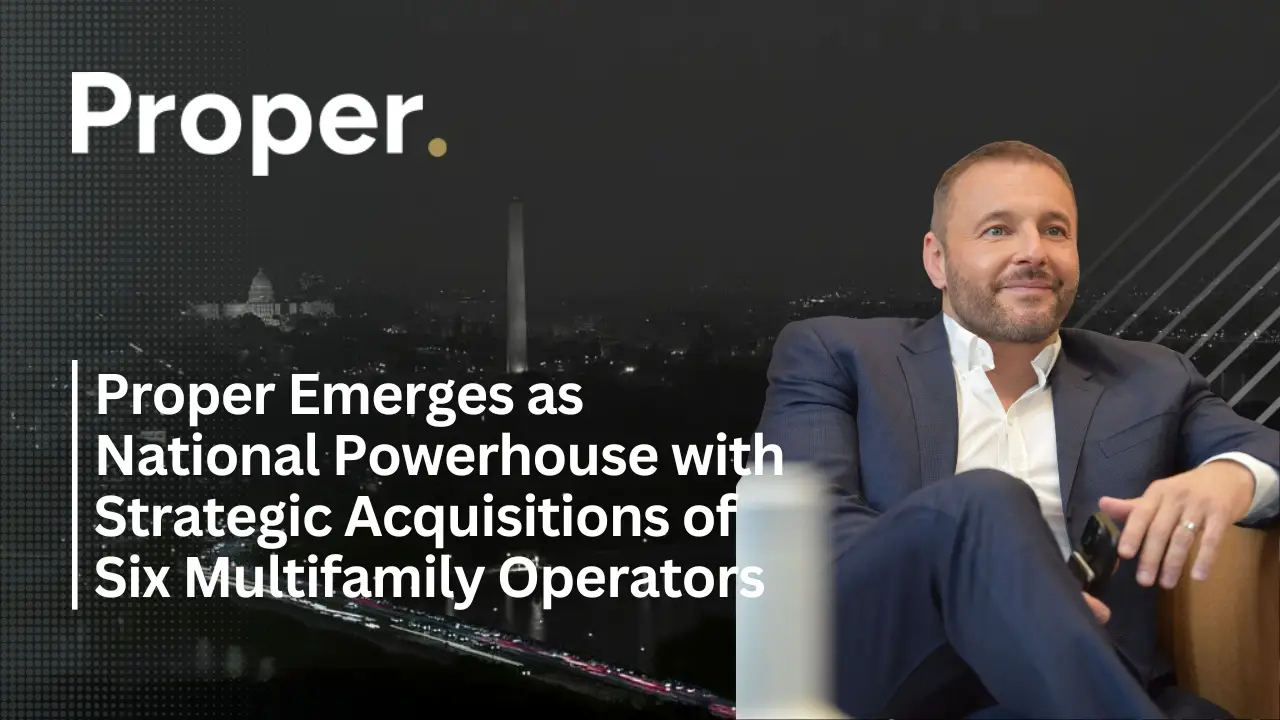
Proper announced the addition of two operating companies, Novo Properties and Alexander Properties Group (APG), bringing the platform to six companies in total: Novo Properties, APG, FLATS, Guardian, CommonPlace, and Drexel. With these additions, Proper now spans 15 states and nearly 20,000 units.
This milestone matters because it signals more than footprint. It signals an operating model that is designed to scale without breaking the two things that historically drive long-run outcomes in property management: accountability close to the resident, and stable teams close to the asset.
The Core Idea: Scale Without Cultural Disruption
Many consolidations struggle after close for a predictable reason: integration is treated as a speed exercise rather than a performance exercise. When systems, processes, and teams are standardized too quickly, local strengths get erased, adoption drops, and service quality becomes inconsistent at the moment stability is most needed.
Proper’s approach is built around “Flexible Autonomy” – a measured integration model intended to avoid forced, immediate system and cultural consolidation. The objective is not to keep everything decentralized. The objective is to centralize what reliably improves outcomes and lowers friction, while protecting the local stewardship that produced performance in the first place.
A practical way to think about Flexible Autonomy is: outcomes are standardized, decision rights are explicit, and execution remains local.
How Flexible Autonomy Works In Practice
In most markets, high-performing property management teams win through consistency. They know their residents, understand local vendor ecosystems, and operate with market-specific judgment. A platform should not replace that. It should reduce the operational drag around it.
Flexible Autonomy is designed to do three things at once:
Preserve local performance drivers
- Maintain local operating leadership and accountability
- Protect resident experience and service responsiveness
- Keep what already works, especially in market-specific routines
Add enterprise-grade capacity
- Shared services that reduce administrative burden
- Procurement leverage where scale improves pricing and quality
- Analytics and reporting that clarify performance and variance
Govern integration intentionally
- Align on a common operating cadence and measurable standards
- Sequence systems change based on readiness, not a calendar
- Ensure adoption, training, and controls before “go-live” expansion
A Value Creation Framework Tailored To Proper’s Model
Proper’s platform is structured around five levers that consistently drive performance in services businesses, particularly in multi-site operations:
People
Process
Technology
Capital
Governance
What This Means For Operators And Owners
For strong operators, the practical promise of this model is simple: keep local execution strong while reducing the constraints that limit scale. For ownership groups, the platform aims to increase consistency, transparency, and operational leverage without compromising the human and local elements that drive retention and service quality.
In a fragmented industry, the question is not whether consolidation will happen. It is whether it will be done in a way that protects performance, retains teams, and builds enterprise value over time.
Transaction Structure and Capital Discipline
Founder-operators evaluating partnerships typically prioritize both economics and continuity. Beyond valuation, owners often focus on liquidity timing, post-close involvement, employee stability, and long-term planning. These considerations are highly fact-specific and should be evaluated with independent advisors. In many M&A and recapitalization contexts, common structuring topics include the mix of cash and equity, contingent consideration design, payment timing mechanics where applicable, entity and allocation decisions, and coordination with longer-term planning objectives.
Executive Q&A
What is "Flexible Autonomy" in property management consolidation?
Why do many consolidation efforts underperform after close?
What changes for onsite teams after an acquisition in this model?
How does the platform protect resident experience during integration?
Where does scale create real operating leverage in property management?
How does the model avoid "tool sprawl" as the platform grows?
What does "liquidity with continuity" mean for seller-operators?
How should owners think about tax-aware structuring in general terms?
Owners often evaluate structure alongside valuation, including the mix of consideration, timing, and alignment with longer-term planning. These topics are jurisdiction- and fact-dependent and should be reviewed with qualified advisors as part of a holistic transaction plan.
Philanthropic Philosophy
The Future of PropTech & AI
PropTech and AI are reshaping how multifamily teams lease, operate, maintain, and serve residents. The winners are not the teams with the most tools. They are the teams with the clearest operating model, the cleanest data flows, and the strongest governance controls.